
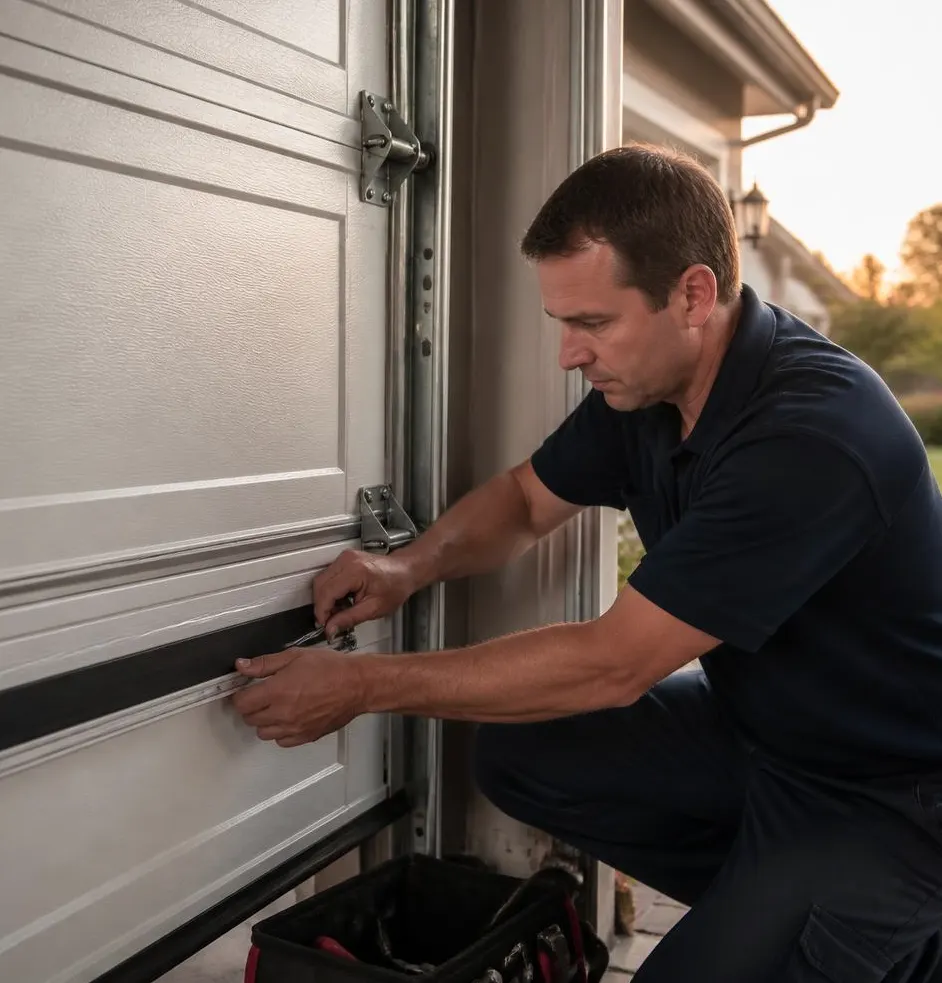
Short answer: your garage door is the weakest point in your home's shell, and fall storms off Lake Michigan are exactly the kind of wind event that exposes that weakness
A garage door is the largest moving opening in most homes, built from thin panels and held in place by tracks, rollers, and a handful of hinges rather than the solid framing that holds up the rest of your walls. When wind pressure builds against a house, that door is usually the first thing to give. Once it fails, wind rushes into the garage and pushes up against the roof and interior walls from the inside, which is how a storm turns a bent door into a torn-off roof. Preparing the door before the next round of fall wind rolls in off the lake is one of the most overlooked ways to protect the rest of the house.
Why this time of year matters on the lakeshore
Fall along the Holland area and the rest of the Lake Michigan shoreline brings fast-moving storm systems with strong, gusty wind, sometimes well ahead of the hard winter cold that shows up later. These autumn wind events can hit harder and more suddenly than summer storms, and they arrive right as homeowners are focused on raking leaves and closing up pools, not checking garage door hardware. A door that's been quietly losing strength all year, through worn rollers, a sagging track, or a panel that took a hit from a stray branch, is far more likely to fail under a sudden gust than one that's been kept in good working order.
What actually makes a garage door weak against wind
- Track alignment: Tracks that have drifted even slightly out of parallel let the door flex more than it should when wind pushes against it, which can pop rollers out of the track entirely.
- Worn rollers and hinges: These are what keep the door rigid as a single unit. Once they're loose or cracked, the door panels can bow independently instead of resisting pressure together.
- Panel dents and cracks: Even cosmetic-looking damage from a summer hailstorm or an errant basketball can weaken a panel's structural integrity right where wind load concentrates.
- Light-duty springs: Springs under tension help keep the door seated and balanced. A spring that's stretched, rusted, or mismatched to the door's weight won't hold the door steady under pressure the way it should.
- No bracing: Many older or standard residential doors were never built with horizontal wind bracing, which is the main thing that keeps a door from buckling inward or outward in a storm.
Steps to take before the next storm system comes through
- Inspect the tracks. Walk the full length of both tracks and look for gaps, dents, or spots where they've pulled away from the wall. A track that's even a little bent under load is a track that can let go in high wind.
- Check rollers and hinges for wear. Cracked nylon rollers or hinges with visible rust and play should be replaced before storm season, not after something fails.
- Tighten all hardware. Vibration from regular use loosens bolts and brackets over time. A full pass with a wrench on track brackets and hinge bolts takes a half hour and closes off one of the most common failure points.
- Look at the panels. Dents that have pushed inward, especially near the edges of a panel, reduce the door's ability to flex and recover under pressure. Minor dents can sometimes be addressed without replacing the whole section, but deeper damage usually calls for panel replacement.
- Add or verify wind bracing. Retrofit bracing kits run from roughly $50 to $150 for materials on a standard residential door and can be added to most existing doors without replacing the whole unit. For homes that see consistent high wind exposure, a wind-rated door built with reinforced struts is a stronger long-term option, generally costing more upfront than a standard door but reducing the chance of a full failure.
- Make sure the opener has a manual release that actually works. If the power goes out during a storm, which happens often enough on the lakeshore, you want to be able to operate the door by hand without a fight. Test the release cord now, not during an outage.
- Check weatherstripping and bottom seals. Worn seals let wind-driven rain push into the garage, which adds weight and moisture stress to a door that's already working hard against gusts.
The trade-off homeowners usually weigh
Bracing kits and hardware tune-ups are the lower-cost route and meaningfully improve a door's wind resistance without a full replacement. A wind-rated door is the better long-term fix if the current door is already older, has taken repeated damage, or is due for replacement anyway. Trying to stretch an aging, already-worn door through another storm season with patchwork fixes usually costs more in emergency repairs than addressing it properly once.
When to call Holland Garage Door Pro
If your door is slow to open, doesn't sit flush against the weatherstripping, or has visible track or panel damage, it's worth having it looked at before the next storm rather than after. Our Garage Door Maintenance service covers a full hardware inspection, lubrication, and balance check so the door is working as one solid unit instead of a collection of loose parts. If the door itself is outdated or already compromised, our Garage Door Installation service can get you into a model built to handle serious wind load, including bracing options suited to lakeshore weather.
If you're in Holland, Zeeland, Grand Haven, Saugatuck, Douglas, Hamilton, Fennville, or West Olive and want your garage door ready before the next system rolls in off the lake, give Holland Garage Door Pro a call. We'll check it, brace it, or replace it, whatever it actually needs.