
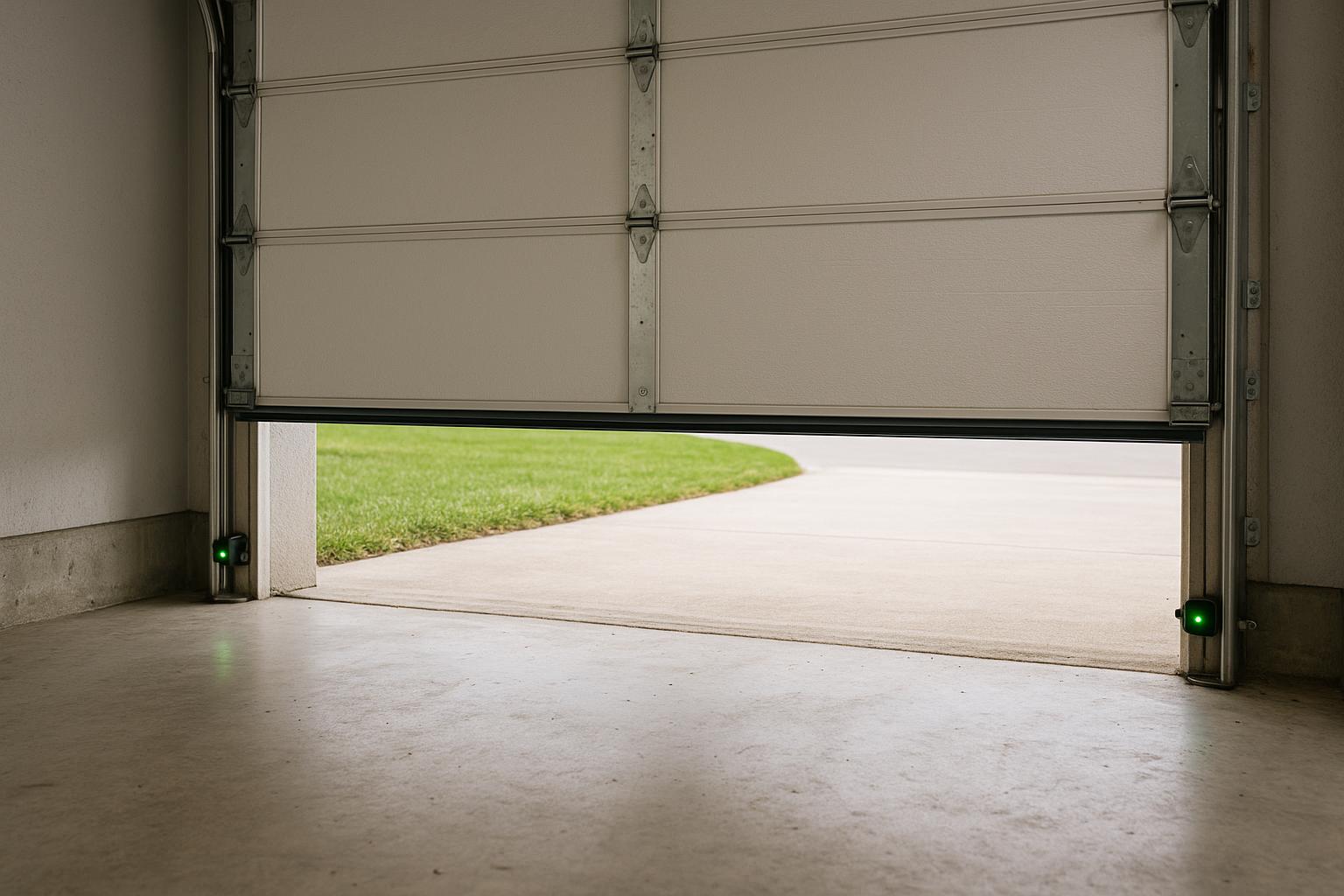
That Frustrating Moment When Your Garage Door Won't Stay Closed
You press the button on your remote, watch your garage door glide downward, and then — just inches from the floor — it stops, reverses, and goes right back up. You try again. Same thing. Maybe it worked fine yesterday, but today it refuses to close all the way.
This is one of the most common garage door complaints we hear from homeowners here in Holland, MI. The good news is that in most cases, the cause is straightforward and fixable. The bad news is that ignoring it leaves your garage — and everything inside it — exposed to weather, pests, and security risks.
Let's walk through the most likely reasons your garage door reverses before hitting the floor and what you can do about each one.
1. Something Is Blocking the Safety Sensors
Every garage door opener manufactured after 1993 is required to have photoelectric safety sensors — also called photo eyes — mounted near the bottom of the door tracks on either side. These sensors project an invisible beam across the opening. If anything breaks that beam while the door is closing, the opener reverses the door to prevent crushing a person, pet, or object.
This is the single most common reason a garage door reverses, and it's often the easiest to fix:
- Check for obstructions. A broom handle, a shoe, a trash can, or even a leaf pile near the sensor can trigger the reversal. Clear anything from the path between the two sensors.
- Clean the sensor lenses. Dust, cobwebs, and grime build up on the small lenses over time. Wipe them gently with a soft cloth.
- Check the alignment. Each sensor has a small LED indicator light. If one is blinking instead of glowing steadily, it's likely misaligned. Gently adjust the sensor bracket until the light holds steady. Both sensors need to point directly at each other.
- Look for sun interference. During certain times of day, direct sunlight can overwhelm the sensor's infrared beam. If your garage faces west — common in many Holland neighborhoods — afternoon sun can be the culprit. A small shade or cardboard tube around the sensor lens can help.
2. The Close-Limit Switch Needs Adjustment
Your garage door opener has limit switches that tell it how far the door should travel when opening and closing. If the close-limit setting is off, the opener may think the door has hit an obstruction when it's actually just reaching the floor. The opener's built-in safety response is to reverse.
Most openers have adjustment screws or dials — usually labeled "down limit" or "close limit" — on the back or side of the motor unit. Turning the screw slightly in the correct direction (check your owner's manual) tells the opener to travel a bit farther before stopping. Small adjustments make a big difference, so turn the screw in quarter-turn increments and test after each one.
If you're not comfortable making this adjustment yourself, this is a quick fix for a professional technician.
3. The Close-Force Setting Is Too Low
Separate from the limit switch, most openers also have a force adjustment that controls how much resistance the motor will push through before reversing. If the close force is set too low, the door may reverse from normal friction in the tracks or even from its own weight.
This can happen after seasonal temperature changes — something we deal with regularly along the West Michigan lakeshore. Cold weather thickens the lubricant in your tracks and rollers, creating more resistance. A force setting that worked perfectly in July may cause reversals in January.
Again, this is typically a small screw adjustment on the opener unit. But be cautious: setting the force too high can create a safety hazard. The door should reverse if it encounters a real obstruction. If you're unsure, it's best to have a technician calibrate it properly.
4. Worn or Damaged Rollers and Tracks
Over time, the rollers that guide your garage door along the tracks can wear out, crack, or accumulate debris. Bent or misaligned tracks create friction points that the opener interprets as an obstruction, triggering a reversal.
Walk along both tracks and look for:
- Visible dents or bends in the metal track
- Rollers that are cracked, chipped, or no longer spinning freely
- Gaps between the rollers and the track
- Debris, rust, or hardened grease buildup inside the track channel
Replacing worn rollers — especially upgrading from plastic to nylon rollers — can make a dramatic difference in how smoothly and quietly your door operates. Track realignment is a job best left to professionals, since the door needs to be properly supported during the process.
5. Broken or Weakening Springs
Your garage door springs do the heavy lifting — literally. They counterbalance the weight of the door so the opener motor doesn't have to work as hard. When springs weaken with age or partially break, the door becomes heavier than the opener expects. The motor strains, detects excessive resistance, and reverses.
Signs of spring problems include:
- The door feels noticeably heavier when you lift it manually
- The door opens unevenly or appears crooked
- You hear loud squeaking or grinding from the spring area
- There's a visible gap in a torsion spring above the door
Important safety warning: Garage door springs are under extreme tension and can cause serious injury if handled improperly. Spring replacement should always be performed by a trained technician. This is not a DIY project.
6. Wiring Issues or a Failing Opener
If you've checked everything above and the door still reverses, the problem may be electrical. Frayed wires running to the safety sensors, a short in the wall-mounted control panel, or a failing logic board inside the opener can all cause erratic behavior.
Garage door openers typically last 10 to 15 years. If yours is approaching that age and developing multiple issues, replacement is often more cost-effective than repeated repairs. Modern openers also offer significant upgrades in safety features, noise reduction, smartphone connectivity, and battery backup — a real advantage during West Michigan storms when power outages are common.
When to Call a Professional
Some of these fixes — clearing sensor obstructions, cleaning lenses, and minor limit adjustments — are well within the ability of most homeowners. But if you've tried the basics and the problem persists, or if the issue involves springs, tracks, or electrical components, it's time to call in a professional.
At Holland Garage Door Pro, we diagnose and repair reversing issues for homeowners across Holland, Zeeland, Grand Haven, Saugatuck, Douglas, and Hamilton. We carry common replacement parts on our service vehicles so most repairs are completed in a single visit.
A garage door that won't close isn't just an inconvenience — it's a security and weather exposure risk. If your door is reversing and you can't pinpoint the cause, give us a call. We'll get it closing properly and keep it that way.